Nobody plays exactly the same game. The official rules cover how to play a hand, not the dozen small questions a Tuesday table runs into by nine o'clock. Here is what is worth settling out loud, and what the named variations actually mean.
Get the free score sheet It has a row at the top to write your rules in.
The National Mah Jongg League publishes a new card every April and a set of rules that go with it. Those rules are thorough about the things that decide a hand: how many tiles you hold, what you may call, when a hand is dead, what the winner is paid. Tournaments and online play follow them to the letter, and if you are playing with strangers you should assume that is the game.
A house rule, which plenty of people call a table rule, is anything your own group decided instead. Sometimes it fills a gap the official rules leave open. Sometimes it changes an official answer on purpose, because the official one was built for competition and your group is four friends and a bowl of pretzels. Neither is cheating. It is how the game has always worked at kitchen tables.
The only real failure mode is the rule nobody wrote down. Four people remember an unwritten rule four different ways, and the disagreement always surfaces in the middle of a hand somebody is about to win.
Most of these take ten seconds to agree on and save an argument later. Where the official rules already have an answer, it is noted.
The official rules are written around players paying each other, usually in coins or chips. A great many casual groups skip that entirely and keep points only.
Worth saying out loud because it changes everything below it. If nothing is being paid, the point values are just a way of keeping score, and you can pick round numbers that are easy to add.
Officially the value printed next to that hand on the current year's card.
Commonly at casual tables a flat number for any win, often 2 points, so nobody is reading values off a card mid-game. Some groups keep the card values anyway because part of the fun is going for an expensive hand.
Officially yes. The player who discarded the winning tile pays the winner double while the other two pay the face value of the hand.
The question for your table is whether you keep that. Groups playing for points only often drop it, because a penalty for a bad throw stings more when there is no money to shrug off.
Officially all three players pay double when the winner draws the tile from the wall rather than taking a discard.
Commonly a flat bonus instead, worth one extra point. It is the single most popular bonus among groups that use flat scoring, and reasonably so, since it is genuinely harder.
Officially a jokerless hand outside the singles and pairs section pays double, and four times the value if it was also self picked.
Commonly one bonus point. Decide now whether a singles and pairs hand counts, because it never uses jokers in the first place and reasonable people disagree about whether that should still earn the bonus.
Officially if the wall runs out with no winner, nobody scores and you deal again.
The gap is whether that hand counted at all. If you are tracking a season, a night with two wall games out of four hands looks very different depending on whether you count hands played or hands won.
Officially the last wall is just the last wall, with no special status.
The two common variations are described in the next section. Pick one or pick neither, but pick before somebody is sitting on a winning tile.
Whether you play the courtesy pass, how many tiles it can be, and whether you mush. These are so widespread that many players are surprised to learn they are not in the official rules. Confirm it with a new table rather than assuming.
A single evening needs almost no bookkeeping. A running total across months, with people missing weeks and guests filling in, is a different problem, and it is the one that decides whether your scoring rules need to be consistent from week to week.
If it is a season, settle whether a guest's points count, and whether somebody who misses a night takes a zero or is simply not counted that week. Those two answers change who wins.
None of these are National Mah Jongg League rules, and none of them have one settled definition. If a new table says they play one, ask which version.
Once play reaches the final wall, no discard may be called for any reason. The hand finishes on draws alone unless somebody is already set.
Some groups add a penalty on top: a player who discards the winning tile during the hot wall pays for the whole table.
Ask: does the penalty version apply, and where exactly does the last wall start?
The gentler sibling. During the final wall you may still call a discard, but only to declare mah jongg. You cannot call one to make an exposure.
Ask: hot or cold, because the two names get swapped often enough that hearing one is not the same as knowing which you are playing.
An extra hand that is not on the card: seven pairs. Groups that play it generally require you to declare it before the first Charleston pass and turn your card face down, and bar jokers and flowers from the hand. Four of a kind counts as two pairs.
It is contentious. Plenty of experienced players will not play it, on the grounds that it changes what the game is.
Ask: what does it pay, and what happens if you pick up a joker after declaring?
This one has two meanings in circulation, which is exactly why it belongs on a page like this.
In one, at the end of the first Charleston everyone puts their unwanted tiles face down in the middle, they get mixed together, and each player draws back as many as they put in.
In the other, mush is simply another name for the courtesy pass across the table.
Ask which one, every time.
The name comes up on lists of common table rules, but we could not find a single source that says what it does, and we are not going to make one up.
If your table plays it, we would like to know how. See the note below.
The official positions above come from the National Mah Jongg League rules as they are commonly documented. The descriptions of hot and cold wall follow Tom Sloper's long running mah jongg column, which is the closest thing this game has to a reference desk. Atomic is described as the groups who play it describe it.
Beyond that, the honest answer is that American mahjong house rules are an oral tradition. They travel by table, not by book, and the same name means different things two towns apart. If your group plays something worth writing down, send it to hello@themahjreport.com and we will add it, with credit to your table if you want it.
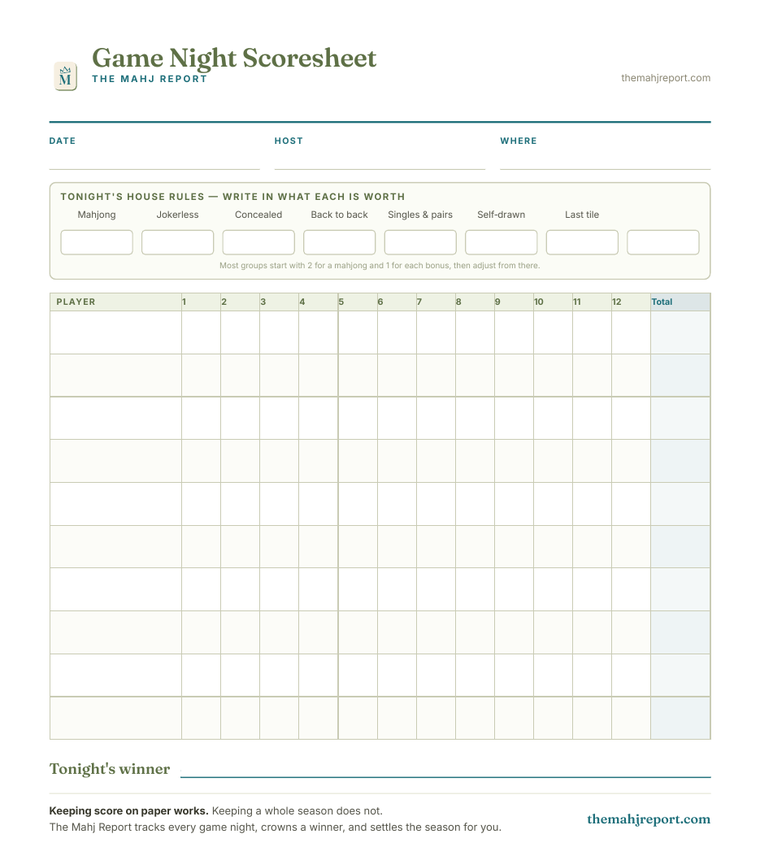
The free printable score sheet has a row across the top for exactly this: what a mahjong pays, what each bonus pays, settled once at the start of the night instead of relitigated every hand. Print a stack and keep them with the tiles.
Get the score sheetA house rule, also called a table rule, is any decision your group made that the official National Mah Jongg League rules do not cover or that your group chose to change. Common ones are what a mahjong is worth in points, whether the person who discarded the winning tile pays extra, what happens when nobody wins, and whether the last wall is played hot or cold. They are normal and expected in casual play. Tournaments and online play follow the League rules exactly.
A hot wall is a table rule for the final wall of the game. Once play reaches it, nobody may call a discard for any reason. Some groups add a penalty for a player who discards the winning tile during the hot wall. It is not an official National Mah Jongg League rule, so the exact version varies by table.
Both are table rules that restrict calling discards during the final wall. Under a hot wall, no discard may be called at all. Under a cold wall, a discard may be called only to declare mah jongg, not to make an exposure. Neither appears in the official rules, so ask which version a new table plays.
Atomic, sometimes called Nuclear, is a table rule that lets a player go for seven pairs instead of a hand on the card. Groups that play it usually require the player to declare it before the first Charleston pass and to turn the card face down, and usually bar jokers and flowers from the hand. Four of a kind counts as two pairs. It is not a National Mah Jongg League hand, and the details differ from table to table.
There are two versions in circulation, which is why it is worth asking. In one, at the end of the first Charleston every player puts their unwanted tiles face down in the middle, they get mixed, and each player draws back as many as they put in. In the other, mush is another name for the courtesy pass with the player across from you. Both are table rules rather than official ones.
Most casual groups use flat points instead of the card values. A common starting point is 2 points for a mahjong and 1 point for each bonus the group agrees on, such as winning without jokers or picking your own winning tile. The numbers matter less than writing them down, because an unwritten rule gets remembered differently by four people.
No. The official rules are written around payment between players, but plenty of groups keep points only and never move any money. If you play that way, a running total across the whole season usually matters more than the value of a single hand.
The Mahj Report is a scoring app for casual American mahjong. Set what a mahjong pays and what each bonus pays, or use the League card's values if that is how your table plays. It keeps the running total, crowns a winner every game night, and settles the season title. Not affiliated with the National Mah Jongg League.
See what it does